Knowledge hub

FAQ

Explore the most common questions about moving to Brazil.

Brazilian citizenship

4 questions

Yes, you do not need to give up your existing citizenship if you want to become a Brazilian citizen. However, your existing country may not allow dual citizenship, which would override this. In such a case, you would need to choose which citizenship you want to keep.

Ordinarily, you need to live in Brazil for four years before you are eligible to apply for citizenship. However, the four-year residence requirement is reduced if any of the following apply to you:

  • You have a Brazilian child or spouse
  • You have outstanding professional, scientific or artistic capacity
  • You own real estate in Brazil

According to the Alien Statute, your period of living in Brazil needs to be:

  • 1 year if you have a Brazilian child or spouse
  • 2 years if you are a foreigner recommended by their professional, scientific or artistic capacity
  • 3 years if you own real estate in Brazil

If you are planning to apply for citizenship and need our help, please request a quote, by emailing hello@livinginbrazil.net.

Yes, every Brazilian citizen has to render military service. However, in times of peace, clergymen and women are exempt. Disabled people have the right to have an Exemption Certificate (CI), which must be requested in Brazil at the nearest Military Service Board. This is something to consider if your children are planning to become Brazilian citizens.

Once 18 years of age, if you are a Brazilian citizen, you need to enlist for military service or you shall be in non-compliance with your military service obligations. Penalties include not being allowed to take office as a civil servant, apply for a passport or enrol in Brazilian higher education institutions.

This rule applies even if you are a Brazilian citizen living abroad. You need to go to your local Brazilian embassy to enlist and receive the Military Draft Certificate (CAM). If you have been living abroad for more than 3 months you can then apply to be definitively discharged from service.

There are a number of documents and declarations you will need to gather, which we can assist you with, including:

  • Criminal record checks from places you’ve lived in the last five years
  • Evidence of Portuguese language proficiency
  • Identification documents, including some issued in Brazil
  • Declaration that you intend to adapt your name, so it is in line with Brazilian names
  • Evidence that you have a Brazilian spouse / partner and/or child

If you are planning to apply for citizenship and need our help, please request a quote by emailing hello@livinginbrazil.net.

Coming to Florianopolis

6 questions

In Florianópolis, there are two types of rental property – short-term and annual. As the name suggests, if you aren’t renting for a full year, then you’re renting short-term.

If you are not intending to stay on in Brazil after you obtain permanent residency, then we recommend booking your own accommodation through a site like Airbnb. While there is a premium to pay when using these sites, it also means you have protections through these sites, and support in your own language via their customer service teams.

If you book a package of services with us, we are happy to advise you on best neighbourhoods on the island, and to look at the properties you are considering, so we can give you pros and cons of the area, the transport connections, the surrounding streets, etc, to help you make an informed decision.

If you are looking for a long-term rental, we can help you with this. We are well connected within Florianópolis. There are many advantages to us finding and booking your accommodation for you:

  • We have existing relationships with Brazilian landlords and are able to negotiate on the price, to ensure you are getting the best deal possible
  • We know the island like the back of our hand – we know the neighbourhoods that best suit your needs (in terms of public transport, supermarket and school facilities, traffic, etc.)
  • When we look for accommodation for you, we look where the locals do – physical bulletin boards in supermarkets and squares, local Brazilian websites and of course, through our own private networks

This is a difficult question to answer, much like ‘How long is a piece of string?’ because we all have different tastes, needs and lifestyles, and these all have an impact on how much money we spend each day.

We recommend you visit Numbeo, a useful tool which allows you to compare the cost of living in your own city to the cost of living in Florianópolis.

When compared to other Brazilian cities, like Rio de Janeiro and São Paulo, the cost of living in Florianópolis is noticeably lower.

Accommodation is likely to be your biggest expense while you’re in Brazil. If you are planning on living in Brazil for an extended period of time (for a year or more), you will find it a relatively affordable place to live. The cost of a 1-bedroom rental starts at around R$3,000.

If you are staying for a shorter period, or during high season, you can expect to pay more. There are ways to avoid the high season price jump, like choosing to stay across the bridge on the continent, or by staying in neighbourhoods that are not near the beach. We have a network of landlords that we work with to help find the best value accommodation for our clients.

You can convert the above prices from Brazilian reais to your own currency here.

Florianópolis is located on a fairly large island, which would take about 2 hours to drive from top to bottom (depending on the traffic, which can get pretty hectic during summer!)

That being said, there is a good bus network which covers most of the island, as well as smartphone apps like Uber and EasyTaxi, which are quick, cheap ways to get around.

If you want to be free to discover the hidden gems on the island, you will need a car, but if you want to keep costs down, we recommend just hiring one for a week or two, or perhaps just on the weekends.

If you do decide you want to rent a car, we recommend Avis and Localiza. Both have offices at Florianópolis airport.

The majority of international flights arriving in Brazil will land in either São Paulo or Rio de Janeiro. You will need to transfer to another domestic flight to Florianópolis, but don’t worry – there are plenty of flights per day and the journey is only 1 hour, 10 minutes from São Paulo and 1 hour, 35 minutes from Rio.

Before you book your domestic flight, make sure you know each airlines’ rules for flying while pregnant. For help choosing a Brazilian airline, click here.

Click here to skip to information on São Paulo

Arriving in Rio de Janeiro

International flights into Rio de Janeiro will land at Galeão Airport. This airport is the country’s second busiest airport, and is located on an island, about 30 minutes by car from the zona sul (south zone) of Rio.

RIOgaleão - O Guia do Aeroporto - Passageiro de Primeira

Where to stay in Rio de Janeiro

Some international visitors want to spend a night or two in Rio, just to rest and adjust before continuing their journey. We recommend you stay in the Zona Sul part of town, as this is safer and more suited to tourists. Zona Sul neighbourhoods (Flamengo, Botafogo, Copacabana, Leblon, Ipanema, Barra da Tijuca, Urca, Lagoa, Jardim Botânico) are more expensive, but in Rio, location is important, as some neighbourhoods are not simply safe for tourists to enter.

Taxis from Galeão Airport

Tourists usually will arrive at the airport, walk straight outside from Arrivals and find many white taxis waiting for them. These taxis will always cost you more, because they know you are a new arrival and unsure of the appropriate price. We recommend you take a yellow taxi from Departures. Jump into a cab that is dropping off passengers at the airport. Also, it is best if the taxi uses the meter. Simply ask them “Pode ligar o taxímetro por favor?”

Taxis use two fare rates, labelled 1 and 2, and you will see which fare type is being used on the meter. Rate 1 (Bandeira 1) applies from 6am to 9pm Monday through Saturday. Rate 2 applies from 9pm to 6am and all day Sunday and public holidays. In December, taxis use rate 2 at all times. Make sure your driver is using the correct fare rate.

Motoristas que usam o 'Taxi Rio' reclamam do critério de seleção do  aplicativo, que beneficiaria inscrições mais antigas

Please, always use licensed yellow taxis when in Rio. Do not be tempted to take public transport after dark to save money. You can estimate how much your taxi will cost by using the Taxi Fare Finder website. You can also take Uber cars from Galeão too. Follow these instructions to book your Uber.

Flying from Rio de Janeiro to Florianópolis

If you are not staying in Rio de Janeiro and wish to transfer straight through, you will still need to collect your luggage, clear customs and immigration before boarding your next flight.

If you are staying in Rio de Janeiro for a short period before travelling on to Florianópolis, you have two options for airports to depart from. Santos Dumont Airport is located in the city, so it is much cheaper to reach by taxi. The views over Sugarloaf Mountain and downtown Rio are stunning as you depart. However, there are no direct flights to Florianópolis from this airport, so you’ll need to connect in São Paulo.

Alternatively you can return to Galeão International Airport for direct flights to Florianopolis.

Aeroporto Internacional de São Paulo, em Guarulhos, bate recorde histórico  na movimentação de passageiros em 2024 — Portos e Aeroportos

Arriving in São Paulo

International flights into São Paulo will arrive into Guarulhos Airport, which is the busiest airport in the country. Guarulhos is not located in the city of São Paulo itself. It’s actually located in another city (called Guarulhos, hence the name). The airport is a 30-minute taxi ride away from the heart of the city.

Where to stay in São Paulo

If you are just staying overnight for a quick rest, we recommend just booking an airport hotel. There are some nice, cheap hotels in Guarulhos and you might find it less stressful than dealing with the traffic and chaos of this concrete jungle.

However, if you want to experience the rat race that is São Paulo, we recommend you stay in and around Consolação, Jardins, Jardim Paulista, Brooklin, Vila Madalena, Moema, Vila Mariana, Bela Vista and República.

Taxis from Guarulhos Airport

Some airport hotels may offer a shuttle bus from the airport, but if you are staying in São Paulo itself, we recommend you take a taxi into town. Similarly to Rio, tourists usually will arrive at the airport, walk straight outside from Arrivals and find special airport taxis (Guarucoop radio taxis) waiting for them. These taxis charge a flat rate to the city, which is more expensive than the regular price that the ordinary taxis will charge. However, if you are travelling between 6-8pm, you will hit traffic, so the flat rate fare might be a better idea.
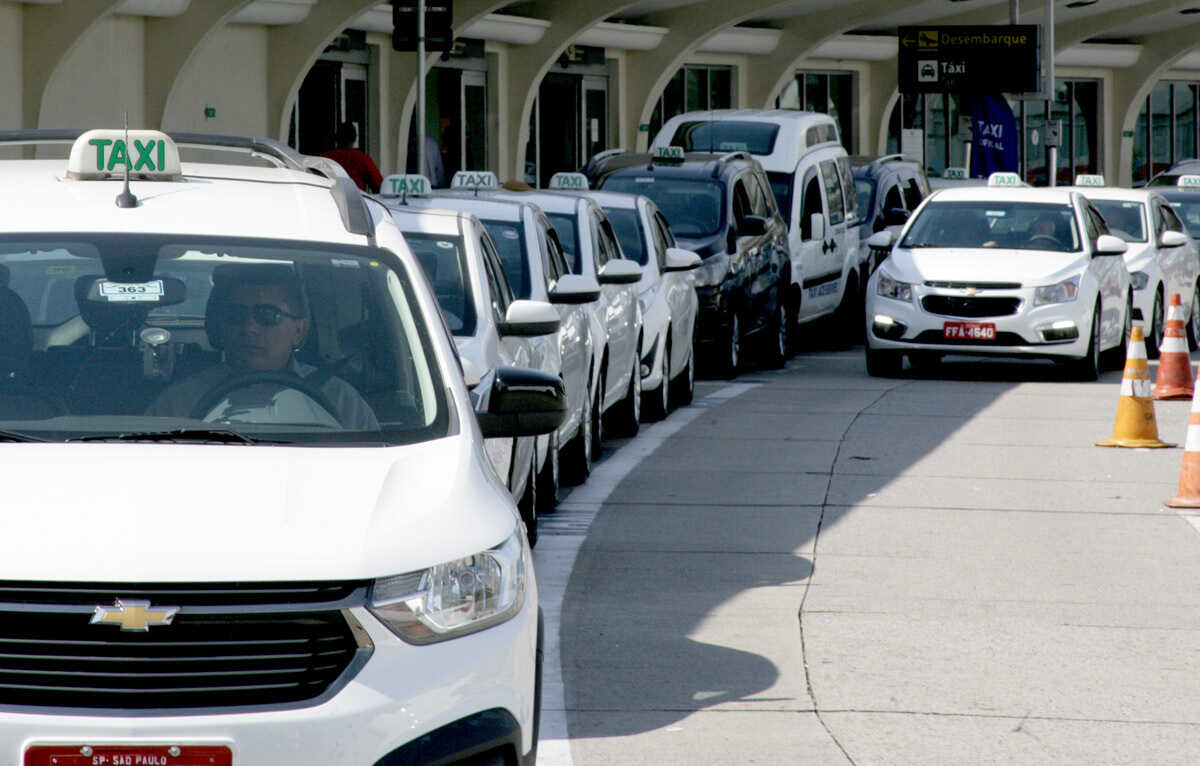
Tarifa de táxi em SP sobe em agosto: veja quanto vai custar a corrida -  Gazeta de São Paulo

If you are travelling outside of these hours, and you want to save some money, we recommend you take a regular taxi from departures. Grab one that has just dropped off passengers at the airport. São Paulo regular taxis are all white with TAXI SP on the side. It is usually best if the taxi uses the meter. Simply ask them “Pode ligar o taxímetro por favor?”

Taxis use two fare rates, labelled 1 and 2, and you will see which fare type is being used on the meter. Rate 1 (Bandeira 1) applies from 6am to 8pm Monday through Saturday. Rate 2 applies from 8pm to 6am and all day Sunday and public holidays. Make sure your driver is using the correct fare rate. You can estimate how much your taxi fare will cost by using the Taxi Fare Estimator website.

You can also use Uber to collect you at Guarulhos Airport. Follow these instructions to make your booking. Make sure you have your phone’s data roaming switched on, as the free airport wifi will not work once you walk outside the terminal.

Flying from São Paulo to Florianópolis

If you not staying in São Paulo and wish to transfer straight through, you will still need to collect your luggage, clear customs and immigration before boarding your next flight.

Conheça as 10 curiosidades sobre o aeroporto de Congonhas - Gazeta de São  Paulo

São Paulo has several airports. If you chose to stay at an airport hotel out at Guarulhos when you arrived, it makes sense to leave from there. If you decided to stay in São Paulo, it is better to leave from Congonhas Airport, as it is centrally located and much cheaper to reach by taxi. The views over the São Paulo skyline are spectacular as you leave. There are direct flights to Florianópolis available from both airports.

International visitors to Brazil will usually fly into Rio de Janeiro or São Paulo and will need to book another onward flight to Florianópolis. Please click here for information on transiting through these cities.

These days, aviation safety standards in South America are equal to those found in Europe. Every year, the European Union publishes a list of airlines that are banned from EU airspace due to safety concerns. No South American airlines are on this list.

When flying domestically in Brazil, here are the airlines you can choose from.

LATAM Airlines

Nossa frota | LATAM Airlines

LATAM (previously known as TAM) joined forces with the Chilean airline LAN Chile back in 2012 and LATAM is the result. This airline is Brazil’s national carrier and is the largest airline in the country. It’s a member of the Oneworld Alliance. Safety rating: 6/7.

GOL Airlines

GOL divulga plano de reestruturação financeira para evitar falência | Startupi

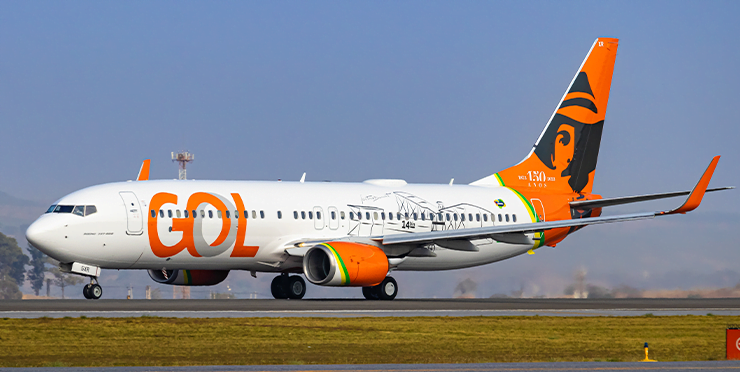
Gol is Brazil’s second-largest airline by market share and has been in business since 2001. Safety rating: 7/7.

Azul Linhas Aéreas

100+] Papéis de Parede de Azul Airlines | Wallpapers.com

Azul is Brazil’s newest airline, and is the country’s third largest. It has been operating in Brazil since 2008 and has the same founder as Jet Blue in the USA. Safety rating: 7/7.

How can I find the best price?

The best tools to compare the prices of Brazilian domestic airlines are Decolar.com (which is named after the Portuguese verb for taking off) or Skyscanner.net.

Florianópolis is a wonderful city, with many varied neighbourhoods to enjoy. It really does have something for everyone, from the upscale mansions of Jurerê to the vibrant café-lined streets of Lagoa da Conceição and the tall, shiny apartment blocks along Beira Mar.

We’ve created an interactive map of Florianópolis that allows you to explore the island’s various neighbourhoods and all that they have to offer. Click on the icons to see how close neighbourhoods are to supermarkets, shopping centres, bus interchanges and hospitals. View the map in full screen here.

General visa application questions

4 questions

Unfortunately we are not able to assist with your tourist visa application. You need to do this yourself at your nearest Brazilian embassy in your home country. If you have specific questions, please ask us, as we may be able to give general advice. We are unable to provide legal advice unfortunately.

Yes, if you are planning to lodge a permanent residency visa application in Brazil, you will need to supply a police check with an apostille fixed to the original document, as part of your permanent residency application.

Please note: if you wish to work with us and you have a criminal record of any kind, you need to tell us this in advance, so we are aware of the situation before you arrive and can advise you accordingly.

Once you have paid a deposit for our services, we will share a list of documents that you need to bring with you to Brazil. If you are planning to apply on the grounds of marriage, giving birth or if you intend to study, these documents are relatively straightforward to organise before you leave.

Once you arrive in Brazil, we will manage the paperwork from beginning to end, which includes any declarations, ID numbers, etc. that you will need to complete your applications.

If you need to go in person to any appointments as part of the process, we will accompany you to translate and manage the process for you.

In the past, Brazil has had a rather relaxed attitude to overstaying on visas. Recent legislative change in the country has brought this era to a close, with financial penalties for overstaying increasing considerably, as of mid 2017.

Overstaying your tourist visa can happen in two cases:

  1. You’ve stayed beyond the 90 [or whatever they give you] days initially granted on your arrival card, or the 90 days granted by your extension.
  2. You’ve stayed in excess of 180 days during your 1 year period.

In the past, you would have been fined R$8.28 per day that you overstay, with the maximum fine being R$828. However with the new Lei da Migração, the fine is now R$100 per day, and the new maximum fine is now R$10,000.

If you have overstayed your tourist visa and you intend to make an application for permanent residency at the Polícia Federal, you will still be allowed to make your application. You will be given an opportunity to lodge an appeal to have your fine minimised or cancelled entirely. We can help you regularise your immigration status in Brazil and write your appeal letter. Please contact us to discuss your situation.

If you are just travelling in Brazil and do not intend to lodge a permanent residency application, you will be given the fine as you leave the country, and you do not have to pay the fine until you want to re-enter Brazil next time you travel. Please note, tourists are allowed a maximum stay in Brazil of 180 days in a one-year period, so you need to stay outside of the country for enough time for the clock to reset.

Giving birth in Brazil

14 questions

Yes. If you give birth in Brazil, you will be required by the government to vaccinate your baby against hepatitis B and tuberculosis.

For more information, please visit:

Last updated: April 2023

Nowadays in Brazil, coronavirus is no longer a major concern for those intending to visit the country. Face coverings are still worn in some settings, e.g. hospitals, taxis, airports, etc. and there is still a need for travellers to present proof of vaccination or a negative PCR test when entering the country.

At the moment Brazil is open for tourists and businesses, hospitals and government services are open as normal. Thankfully lockdowns remain a thing of the past, for now.

We also remind you that only home births and private hospitals are an option for clients, to ensure no added strain is put on the public health system in Brazil.

For more information on the current coronavirus situation in Brazil, please visit the government website.

We pride ourselves on providing a very personal, individualised service to the families that we work with. That means getting to know them, going with them to their appointments, only recommending partners, hospitals, accommodation, etc. that we trust and have seen and experienced ourselves.

Therefore, if you prefer to give birth in another Brazilian city, we can still help you, but not to the same degree. We can complete your application forms, book your appointments, give you instructions and guidance, but you will still need to do a lot of the legwork yourself.

While Rio de Janeiro or São Paulo are arguably Brazil’s most famous cities, they are also more expensive, less safe and more highly populated than Florianópolis – all important things to consider when you are pregnant. If you need further convincing, contact us and we’ll be happy to discuss matters further.

That’s easy. Just fill out the ‘request a quote’ form on our site, and we’ll send you a detailed email giving you details of our prices and the services included.

We work with an experienced team of midwives, who have successfully delivered literally hundreds of babies in homes across the Florianópolis region.

This team charges upwards of R$9,500 for their services, all inclusive. If there are complications with your birth and you need to travel to hospital for delivery, you will be taken to the public hospital, which has great facilities and staff and does not have any additional fees to pay.

We have two private hospitals that we recommend, however we do not give out the names of these hospitals until clients have paid a deposit for our services.

Both hospitals offer excellent facilities, English-speaking staff and a range of comfortable rooms and suites. The standard of care is as good as you would expect to find in a private maternity hospital in countries like the USA or Australia.

In terms of prices you can expect to pay:

  • for a caesarean birth with the doctor on-call: from R$13,000 to R$15,000
  • for a caesarean birth with your own doctor R$26,000 (this amount includes the hospital costs)
  • for a natural birth with your own doctor up to R$18,000

This total includes 2 nights accommodation and breakfast, fees for the obstetrician, paediatrician, anaesthetist and support staff. Higher prices in the range above are due to premium accommodation options and the option of having a tubal ligation as part of your caesarian. Prices are around 30% higher on the weekend and on public holidays.

If you are having twins, you will pay double the pediatrician fee and double the fee for the exams done at the time of delivery.

You can convert the above prices from Brazilian reais to your own currency here.

Prices correct as of October 2025.

This is a difficult question to answer, but we can give you estimates. Please note that since the pandemic, there have been changes to these estimates. Details are below:

How soon to arrive: (at least 5 weeks before the birth, but the sooner the better)

  • We recommend arriving before your 35th week of pregnancy, which means arriving about a month before your baby is born.
  • Your arrival date in Brazil will most likely be determined by the rules of your airline. Please contact your airline to find out how late in the pregnancy you can fly. Also, remember that you will need to fly from Rio de Janeiro or São Paulo, so you need to be aware of the rules for the Brazilian airline you will be using too.

How soon you can travel afterwards: (updated Oct 2025)

  • There were delays last year for permanent residency applications due to covid-19, however these have very much improved. It still takes time to get appointments at the Policia Federal, at the moment it is taking at least 3 months. You have 2 options:
    • you can either choose to give birth and apply for the baby’s passport (this should be in your hand within less than a month after the baby’s birth). This means you can then travel home. You can then apply for permanent residency at a later date, when you can return to Brazil and spend enough time in the country to get this process done;
    • or you can spend enough time in the country to have the baby, apply for the passport and then wait to attend your permanent residency appointments (this could mean staying in the country for more than 3 months after the birth).
  • Whatever you decide, you will need to ensure that you have organised the necessary paperwork to ensure your Brazilian-born baby can return to your home country. (We do not handle this part of the process. You will need to contact your country’s embassy in Brazil.)
  • From a Brazilian perspective, you can travel once you have your baby’s passport. We can collect your permanent residency visas on your behalf and can forward these to you in your next destination.
  • Please ensure that you keep your contact details up to date with the Brazilian authorities.

The short summary – if you can be flexible with the amount of time you can spend in Brazil, we recommend you apply for permanent residency. If you are short on time, just get the baby’s passport and then come back another time. You will always be eligible to apply for permanent residency as the parent/sibling of a Brazilian baby.

The Zika virus made headline news around the world in 2016, when the illness was linked to babies being born with abnormally small heads (a condition known as microcephaly). Fortunately, more than a year later, numbers of cases have dramatically fallen, and Brazil has announced that there is no longer a state of emergency in the country with regards to the mosquito-borne virus.

When news of the outbreak struck, Brazil launched a nation-wide campaign to eradicate the Aedes aegypti mosquito which carries Zika. These efforts have been very successful and have dramatically reduced new cases.

According to the Ministry of Health, 95% fewer cases were recorded from January through mid-April 2017, compared to the same time the year prior. Incidences of microcephaly has fallen as well.

It is important to note that in the state of Santa Catarina, where we are based, no patients have been recorded as contracting the Zika virus in 2017. Last year, there were only five recorded cases in the entire state. Mosquitoes thrive in warm, tropical climates, and while Florianópolis enjoys a warm summer, overall mosquitoes are not as problematic here as they can be in more tropical parts of the country.

That being said, for peace of mind, we recommend that expectant mothers visiting Brazil should wear long sleeves and insect repellant when sitting outside, particularly when near water in the afternoon and evening.

The good news is that both are possible in Brazil. While native Brazilians have a preference for caesarian births, it is possible to request a natural birth at any of the hospitals that we work with.

In a private hospital, the price difference between the two is small. It really comes down to your own personal preference.

Most international visitors will need to take an internal flight from Rio de Janeiro or São Paulo down to Florianópolis. We know it’s a long way to come to Brazil and the last thing you will want to do once you arrive is get on another plane! We recommend you spend one night in Rio de Janeiro or São Paulo when you arrive, then fly down the next day, once you are rested.

It’s important to know what the rules are regarding flying while pregnant. Travel is not recommended seven days before or seven days after delivery. Please note that airlines in Brazil offer preferential service to pregnant passengers, so please make sure the staff know you’re expecting!

Azul Airlines:

If yours is a straightforward pregnancy (not twins, triplets, etc.) there is no need for a medical certificate up to 29 weeks.

Between 30 and 35 weeks, you must present a medical certificate from your doctor (in Portuguese), giving permission to fly.

Between 36 and 38 weeks, you must complete a must present a completed Medical Authorisation form, which will be validated by the airline doctor.

If you’re carrying a multiple birth, or there are risks with your pregnancy, no certificate is required under 29 weeks.

Between 30 and 31 weeks, you must present a medical certificate authorising the trip and complete Azul’s form for pregnant travellers.

Between 32 and 38 weeks, you must complete a must present a completed Medical Authorisation form, which will be validated by the airline doctor.

GOL Airlines:

No medical certificate is required for pregnant women flying up to 27 weeks for a single pregnancy and 25 weeks for a multiple pregnancy.

From 28 to 35 weeks (for a simple pregnancy) or from 26 to 31 weeks (in the case of multiple births), the mother must carry a medical certificate, which must have been obtained within 30 days of travel.

From 36 to 38+ weeks (for a simple pregnancy) or from 32 to 38+ weeks (for multiple births), a medical certificate with a validity of 30 days must be presented. The mother must also carry a declaration of responsibility form, signed by a doctor and the mother.

Mothers should not travel within 7 days of their due date.

LATAM AIRLINES:

There is no need to submit a medical certificate up to 29 weeks, as long as you are in good health.

From 30 weeks, a medical certificate is required, issued no later than 10 days before travel. The certificate must show the following information:

  • Origin and destination of your trip
  • Dates and times of departure and arrival
  • Week of your gestation
  • Authorization from your doctor to allow you to travel by air

From 36 weeks (32 weeks if it’s a multiple birth pregnancy), you will need to present the LATAM Medical Certificate (MEDIF).

From 39 weeks, you will not be permitted to fly with LATAM.

We have a team of qualified midwives that we recommend. They speak English and work in private or public hospitals in Florianópolis. They have successfully delivered hundreds of babies at home.

Once you have paid a deposit for our services, we will connect you with the team, so you can ask questions and they can talk you through what you can expect.

Once you go into labour, the team from of midwives will come to your home. They will bring an inflatable pool, which will be filled with warm water. Pain relief is available should you need it. If there are any complications, you will be taken to the public hospital to complete the birth. There are no extra fees to pay to the public hospital.

If you prefer, you can ask to be taken to one of our preferred private hospitals, however this will mean you incur further fees. You will need to pay your full fees to the midwives as well as to the private hospital.

Estimate of fees for a home birth can be found here.

We have two private hospitals that we recommend, however there is one in particular that we work with the most. Once you have paid a deposit for our services, we will share the details of the hospital.

Our preferred private hospital is an upscale private hospital located a short drive from the centre of Florianópolis. It offers a range of rooms and suites, an on-site restaurant and a fully-equipped labour ward with a spa bath. Medical staff are highly trained and many speak English.

Birth packages here are all inclusive of obstetrician, pediatrician, anesthetist and support staff fees. 2 nights accommodation and breakfasts are included in the rate for mother and father. Both natural and caesarian birth options are available.

When you arrive in Florianópolis we will accompany you on a tour of the hospital, where you can look at the facilities and ask questions of the staff. We will then hand you over to them for your future care. Mothers should be having monthly check-ups in the lead up to the delivery.

Contact us for a quote if you want to know the latest prices for a private hospital birth.

Firstly, if you are not already in Brazil working and paying tax into the public purse, we will not work with you to give birth in a public hospital, as we believe this is unfair to Brazilian citizens.

However, if you’re already in Brazil paying tax, there is a public hospital that we recommend, which is centrally located on the island of Florianópolis. Once you have paid your deposit to reserve your space in our programme, we can take you on a tour of the hospital and send you more information.

The facilities are clean and of a high standard, the staff are well trained and some even speak English – although we cannot guarantee you will have an English-speaking doctor when you are admitted.

There are no fees to pay as this is a public hospital. You will spend 2 nights in the hospital after you give birth, and it is likely that you will be sharing the room with another patient.

Please note that mothers are not given pain relief at the public hospital for natural births. Please take this into consideration when you make your decision about where you want to have your baby.

Caesarian births are only given at the public hospital if medically necessary and this needs to be ascertained via a medical exam first.

Also, as it is the public system, you should remember that the hospital can get very busy and long queues are common. If you have to go to the hospital for a check-up during your pregnancy, try to get there early to avoid the queues.

We have had clients give birth at the public hospital and they have given very positive feedback about the experience.

When you arrive in Florianópolis, we will take you on a tour of the hospital, where you can see the facilities and can speak with the staff and ask any questions you may have. We will then hand you over to the hospital for your future care. You should be having a monthly check-up with a doctor in the lead up to your pregnancy and this can be arranged when you first visit the hospital.

If you’ve been doing your research, you will be aware that Brazil has the highest rate of Caesarean sections in the world.

In 2015, 85% of all private hospital births were Caesareans, while in public hospitals it was more like 45%. These are staggering figures, once you note that the recommendations from The World Health Organization indicate that 10 – 15% is the ideal rate, and that Caesarian births should only be carried out when medically necessary.

Fortunately in July 2015, Brazil passed legislation in an effort to reduce the number of Caesarian births carried out across the country.

Under these new rules, doctors are now obliged to inform expectant mothers about the risks associated with a Caesarian birth, and they need to sign a consent form before a Caesarean can be carried out. Also, doctors now need to justify why a Caesarian birth was required. A complete record needs to be completed by the Doctor, detailing how the labour and birth developed and explaining their actions.

These new rules have had a positive impact, and data from the Ministry of Health indicates that the number of natural births is increasing across the country since the new laws came into force.

Reasons behind Brazil’s high rate of C-sections

  • Obstetricians in private hospitals are paid per birth, and not by the hour, so a fast C-section birth is more appealing to them, rather than a sometimes lengthy normal birth.
  • Many pregnant women have not been adequately informed about the pros and cons of natural versus Caesarian births.
  • Public hospitals in Brazil usually do not provide pain relief, like anaesthetics or an epidural, for natural birth, which can deter women from giving birth vaginally.
  • There is a perception among wealthier circles that caesarian births are a more dignified, convenient option.

The good news for women wanting a natural birth

If you want a natural birth in Florianópolis, you have several options.

home birth is a mid-priced option, which allows you to give birth at home with an experienced team of midwives, who will be able to provide you with some pain relief if you so wish.

The public hospital option allows women to give birth naturally, but without pain relief. On the upside, there are no fees to pay to the public hospital and standards at the public hospital that we recommend are very good. However, please note that if you are not already in Brazil paying tax into the public purse, this is not an option available to you.

The private hospital option also allows women to give birth naturally if they prefer, for basically the same price as a Caesarian. If your budget allows, you can choose your own private doctor, who you can meet beforehand and discuss your wishes and needs. Choosing your own doctor allows you to be honest and upfront from the beginning about the type of birth that you want, and it can give you peace of mind, knowing that you already trust and know your doctor well by the time you get to the labour ward.

We can help you navigate your way through these options, and have successfully found private doctors for clients, based on their medical experience or whether they speak a particular language.

Life in Brazil

2 questions

A very common question that people ask is: ‘is Brazil safe place for visitors?’ The short answer is “yes, but…”

Safety is relative, like it is for any country. It largely depends on where you go, what you do and who you are. Let’s unpack things a bit, to set your mind at ease.

Firstly, Brazil is a huge country. And yes, it has pockets of poverty, gang rivalry and opportunistic crime, but once you’ve spent time here, you will realise that these areas are quite contained (usually far from any place you are likely to be anyway) and it’s quite easy to avoid putting yourself in harm’s way.

Brazil’s big famous cities, like Rio de Janeiro and São Paulo, come with their fair share of dodgy neighbourhoods and questionable characters. But overall, overseas visitors to these cities will feel a warm welcome, and it’s easy to avoid any trouble by knowing where you’re going, blending in, dressing down and avoiding public transport and walking in quiet streets after dark.

Florianópolis, where we are based, is a lovely, safe place. It’s an island city, which is connected to the mainland by a bridge, and the quality of life here is of a high standard. You can walk around Florianópolis without needing to worry – it’s as safe a place as any you’re likely to find in your own home country.

You should take the regular safety precautions that you would take anywhere.

Blend in with the locals

Dress down, don’t flash expensive jewellery or accessories about, and try not to look too much like a ‘tourist’. Don’t carry loads of cash.

If you’re going to be in Brazil over New Year’s Eve, be sure to wear all white clothes, otherwise you’re going to stand out.

Don’t walk around staring at your phone, oblivious to your surroundings – that rule of thumb applies for most parts of the world.

Be careful around cash machines and bus stations

If you plan to go to a cash machine, it’s best to do that during the day, when there are people around. When it comes to Florianópolis, it’s fine to take public transport after dark, just try to avoid walking around on your own at night in deserted places. If you are walking at night, stick to well-lit, populated areas. A tip: download Uber to your phone – it’s a safe and cheap way to get around town.

Swim in safe areas

When it comes to swimming at the beach, take advice from locals and swim between the flags. If there aren’t any, try to swim in the same place where other people are.

If you follow these simple tips, you’ll be fine. However, if you do find yourself in the wrong place at the wrong time, be sure to remain calm and comply as best you can. Then be sure to report any crime to the tourist police.

Emergencies

In case of emergency, you can call the following numbers:

  • Police – 190
  • Ambulance – 192
  • Fire Service – 193

There are many opportunities for work in Brazil for foreigners. However deciding on how you’ll make a living is perhaps the most important question to answer before you embark on a new life in a new country. There are a few big things to consider, so let’s unpack them all.

Do you speak Portuguese?

For most people, this is going to be their biggest stumbling block. English is a great first (or second) language, but unfortunately it won’t get you very far in Brazil. Of course, there are some jobs where English will come in handy (more on that in a moment), but fundamentally, if you are going to live and work in Brazil, you are going to need to learn Portuguese in some shape or form. And the sooner you learn, the more work opportunities will open up to you.

Here are some tools to help you get started learning Portuguese:

Metrô na Zona Sul do Rio de Janeiro
Inside the Rio de Janeiro Metro. Maybe this is how you’ll get to work one day?

What work can I do while I am learning Portuguese?

You have a few options.

One of the positives to come out of the covid pandemic and the lockdowns we endured is that now the world has embraced remote working. In just a few short years, the employment landscape for foreigners in Brazil has totally transformed. It used to be the case that foreigners in Brazil would teach English or require their work to transfer them here. Now, many people can bring their foreign job with them, if their boss agrees.

If you are unable to take advantage of this option, your first move in Brazil should be to seek out jobs that rely on your English-language abilities. English teaching is the obvious choice. Whether you will have work permissions in Brazil will make a big difference when it comes to how much you will be paid and where you can work.

Even without a valid work visa in Brazil, some still choose to teach English privately to students they find themselves. Some schools are so keen to hire native English speakers as teachers, they they will even let people work illegally, cash in hand, without a contract or any formal agreement in place.

With a work visa, you’ll be able to approach the bigger schools, demand higher rates of pay and gain more job security. For more information, I recommend taking a look at a site called Brazilian Gringo. He’s been there and done that and has lots of advice to share.

Of course, just because you speak English, it doesn’t mean you know how to teach it, or that you’ll make a good teacher. You don’t need to have a TEFL or a TESOL qualification to teach English in Brazil, but it would help, purely because it will give you confidence, guidance, some classroom teaching experience and a much better chance at success.

But what if I don’t want to be an English teacher?

There are some alternatives. How about working in a tourism-related role (tour guide, hotel staff, etc.) that relies on being able to speak English? As we said before, some people can work remotely for a business in their home country. Many foreigners live in Brazil but earn their money from jobs overseas. They’re often referred to as ‘digital nomads’ or ‘location independent’ employees.

Jobs that lend themselves to being location independent include:

  • Writer / blogger / editor
  • Social media manager / Digital marketer
  • Graphic or web design
  • Affiliate marketing
  • Owner of an online store
  • Creation and sale of digital products (online courses, newsletters, podcasts, software, etc.)
  • Web developer
  • Translator
  • Virtual assistant
  • Transcriber

Where can you find opportunities like these? You can start by looking at freelancer sites like upwork.com and PeoplePerHour.com or you can look for remote-based jobs on job sites in your home country.

Owning your own business in Brazil is another option, and comes with greater responsibility, but it can allow you to do things your way. You could start as small as being an Uber driver, or perhaps aim for something as bold as running your own pousada or starting your own language school or restaurant?

What if I speak Portuguese?

Well then lucky you! Then your options are wide open. Well almost.

Some of the best-paid jobs in Brazil are with the public service (i.e. the government). However, you cannot apply for public service jobs in Brazil unless you are a Brazilian citizen. Even then, you’ll need to study on courses known as concursos beforehand. As you would expect, competition for these roles is fierce.

You should research the types of roles that you would like to apply for, just so you can have some idea of the salaries you can expect to find in Brazil. Some good places to start:

At the end of the day, it’s up to you to do the research, the study and the preparation before you arrive in Brazil, to give you the best chance of successfully starting a new life here. It’s a big world, there are plenty of opportunities out there, you just have to find them.

Any questions, ask us! We love to help.

Boa sorte!